[Session C3] Welfare Indicators for Fish During Transport

In the previous session, you learned how to identify, assess, and address the main risks to the welfare of Mediterranean marine farmed fish during transport. You also developed the knowledge needed to prepare a comprehensive welfare risk management plan, taking account of the needs of the fish, transport conditions, and contingency measures.
In this session, Welfare Indicators for Fish During Transport, we move from planning and prevention to monitoring and assessment. You will learn how to recognize, record, and interpret indicators that reflect the actual welfare status of juvenile fish during transport.
These indicators will enable you to assess how effectively the risk management plan is implemented in practice and to identify areas for improvement.
By the end of this session, you will be able to:
Distinguish between indicators that assess transport conditions and management practices (resource- and management-based indicators) and indicators that assess the condition of the fish (animal-state indicators) and the resulting welfare consequences (welfare outcome indicators).
Interpret welfare indicators to support decision-making and continuous improvement in welfare management before, during, and after transport.
Understand the biosecurity requirements associated with live fish transport.
As discussed in the previous session, juvenile fish transport comprises the following phases, which must be clearly described in the corresponding standard operating procedure (SOP), as they are critical to safeguarding fish welfare:
Select the numbered markers to see more information.
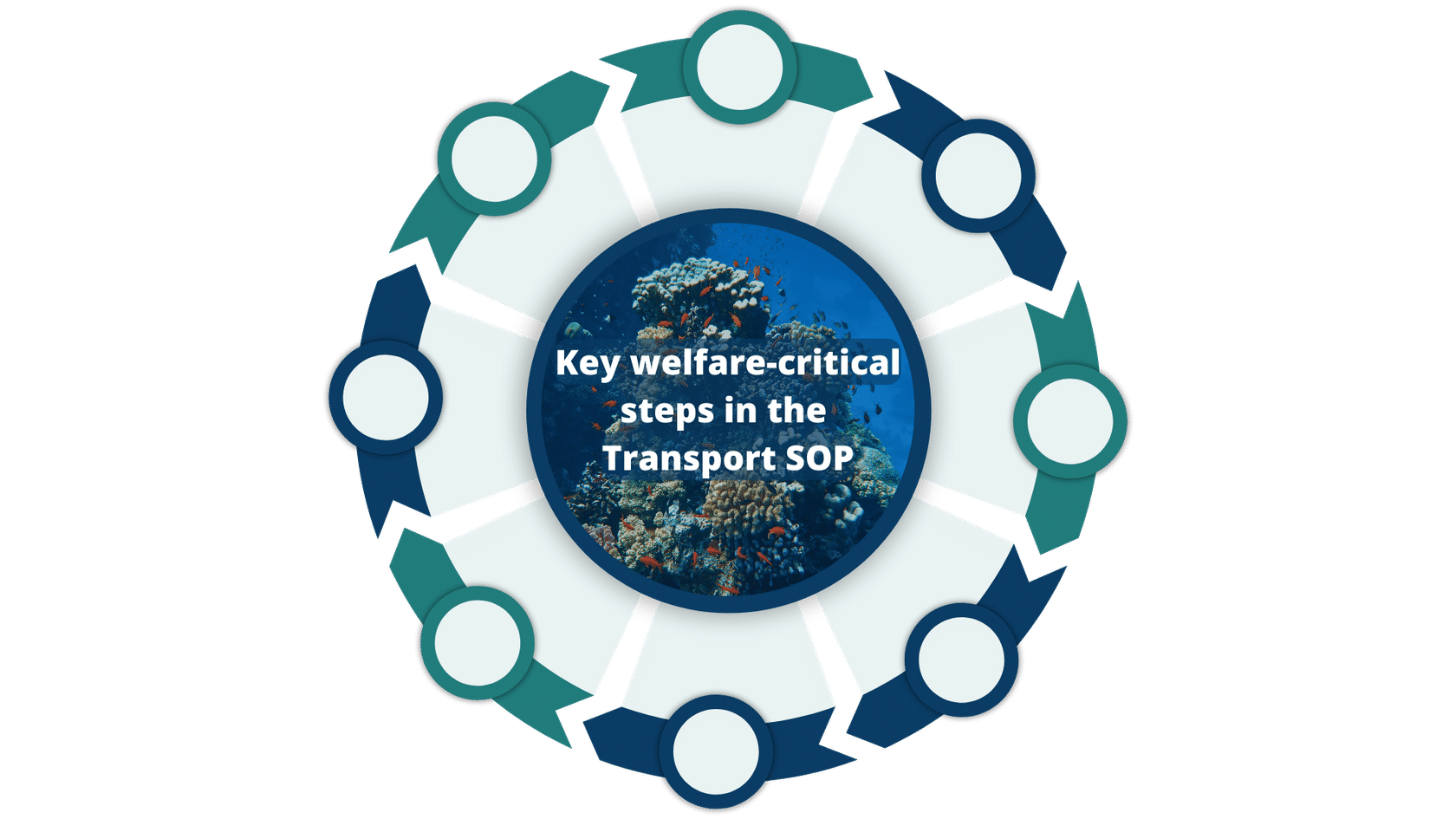
Standard operating procedures (SOPs) describe, step by step, how fish must be collected, loaded, transported, and unloaded to safeguard their welfare at every stage. Developing and monitoring appropriate welfare indicators at each step enables early recognition of deviations, assessment of the associated risks, and corrective action before fish welfare is affected.
As presented in Session A3, welfare assessment combines input-based (indirect) indicators (resource- and management-based indicators) with output-based (direct) indicators that can be used to assess fish welfare. These indicators can be applied throughout transport:
- 1
Before transport (preparation and loading),
- 2
During transport (journey monitoring),
- 3
After transport (unloading and acclimation).
Answer the following question.
Answer the following question.
Match each phase of live fish transport with the appropriate monitoring indicator: